

Guides
Understanding Float Size: A Key to Detecting Stock Market Manipulation
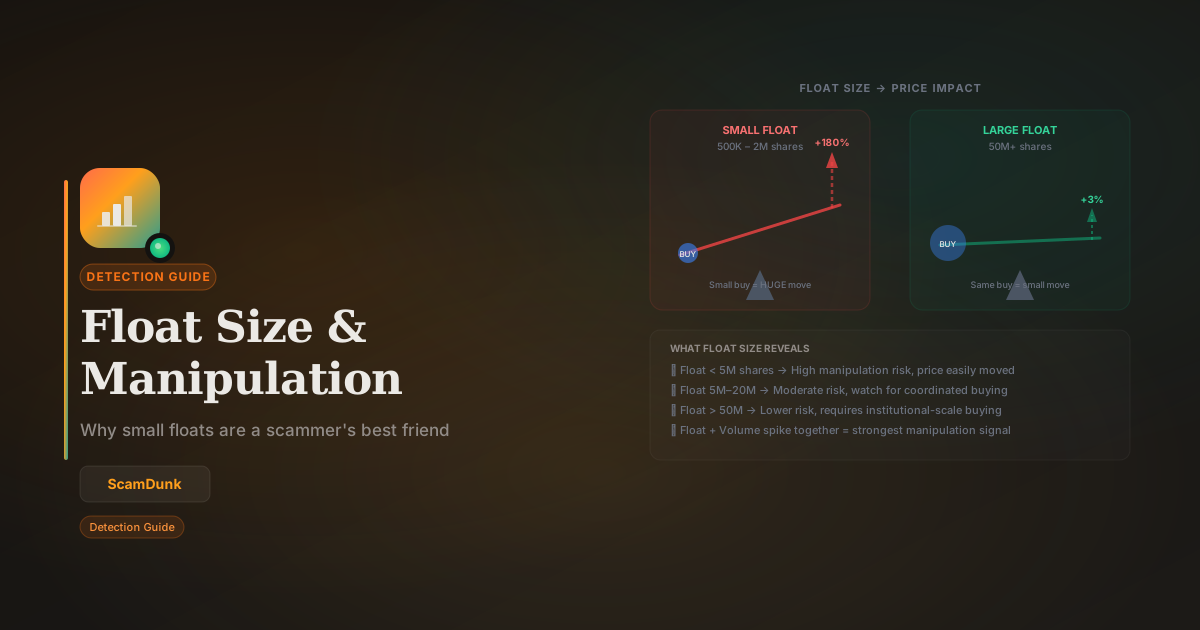
This blog post delves into the critical role of float size in stock market manipulation, particularly in pump-and-dump schemes. It explains how small floats make stocks more susceptible to price manipulation and provides a checklist for investors to identify potential fraud indicators. By understanding float mechanics, investors can better protect themselves in the small-cap market.
Float size is the variable that makes or breaks a pump-and-dump scheme. It determines how much capital an operator needs to move a stock's price, how many shares they must acquire before broadcasting, and how quickly the scheme must execute before it collapses under its own weight. Understanding float mechanics is not optional knowledge for investors operating in the small-cap space. It is the foundation of fraud detection.
What Is a Stock's Float?
Definition: A stock's float is the number of shares available for public trading. It is calculated by subtracting restricted shares (held by company insiders, employees, and early investors under lock-up agreements) and closely held shares (institutional holdings above certain thresholds) from total shares outstanding.
Example calculation:
- Total shares outstanding: 50,000,000
- Insider and restricted shares: 35,000,000
- Public float: 15,000,000
Those 15 million shares are the only ones available for ordinary market participants to buy and sell. This number is the operational constraint that determines a stock's susceptibility to price manipulation.
Float data is disclosed in SEC filings (10-K and proxy statements) and is updated on financial data platforms including Yahoo Finance, Finviz, and EDGAR. For legitimate companies, it is not a hidden variable. For companies being manipulated, it is the central mechanism.
The Float-Manipulation Relationship: Why Small Floats Are Targets
Price is determined by supply and demand. In stock markets, the supply available at any given moment is not the total shares outstanding — it is the float. This distinction matters enormously for manipulation purposes.
Consider two hypothetical scenarios:
Scenario A: A company has 500 million shares outstanding with a 400 million share float. To move this stock 100%, an operator needs to generate buying demand equivalent to a significant fraction of 400 million shares. At even $5 per share, that requires hundreds of millions of dollars in coordinated buying. This is beyond the reach of retail-facing manipulation schemes.
Scenario B: A company has 50 million shares outstanding with a 3 million share float. At $1 per share, the entire float is valued at $3 million. An operator accumulating 1.5 million shares (half the float) has the leverage to create artificial scarcity. When they broadcast a buy signal, any meaningful coordinated buying hits a supply wall — the operator's accumulated position — and the price spikes dramatically.
This mechanics analysis explains why pump-and-dump schemes concentrate almost exclusively in stocks with floats under 10 million shares. The capital efficiency of manipulation scales inversely with float size. Smaller floats require less capital to create the same percentage price increase.
How Operators Engineer Small Floats
Not every small-float company is a manipulation target. But operators who intend to run pump-and-dump schemes sometimes engineer the float structure deliberately before beginning promotion.
Method 1: Reverse Mergers into Shell Companies
A common entry mechanism: operators acquire control of an existing public shell company — a company that completed its SEC registration process but has little to no operating business. These shells often have extremely small floats because most shares are held by the original founders or investors.
Once operators control the shell, they can reverse-merge a private operating company into it, instantly creating a publicly traded entity with a controlled share structure. The original founders (now the operators) hold the majority of shares. The public float remains small. Promotion begins.
SEC filings document reverse mergers through 8-K current reports. An 8-K announcing a change of control or reverse merger, filed by a shell company with minimal operating history, is a foundational fraud indicator.
Method 2: Share Restriction Agreements
Operators can structure financing rounds to include voluntary lock-up agreements that keep large shareholders from selling during the pump period. This artificially constrains supply, creating the conditions for dramatic price movements from relatively modest buying pressure.
These agreements are not always disclosed in detail in public filings, but the net effect — an unusually small float relative to total shares outstanding — is visible in the filings and float data.
Method 3: Toxic Convertible Note Structures
Some manipulation schemes work differently: rather than starting with a small float, they create a mechanism for continuous share issuance. Convertible notes with extremely low conversion prices give the noteholders the right to convert their debt into shares at a discount to the current trading price.
As the operator promotes the stock and the price rises, noteholders convert debt to shares at discounted prices and sell immediately. This creates an effectively unlimited supply that crushes any sustained price increase for legitimate buyers while generating consistent profits for the note structure.
This pattern — a company with convertible debt at steep discounts, constant new share issuance, and promotional activity — is sometimes called a "death spiral" because the continuous dilution prevents any recovery even if the company has legitimate operations.
Identifying Float-Related Manipulation Risk: A Checklist
Check 1: Float Size Relative to Shares Outstanding
Calculate the percentage of shares outstanding that the public float represents.
- Float below 20% of total outstanding shares: high dilution potential, elevated manipulation risk
- Float below 10 million shares: primary target zone for pump-and-dump operations
- Float below 1 million shares: micro-float, susceptible to extreme price manipulation from minimal capital
Find float data on Finviz (free), Yahoo Finance's statistics page, or directly in EDGAR 10-K filings under the capital structure section.
Check 2: Authorized Shares Versus Outstanding Shares
Authorized shares represent the legal ceiling on how many shares the company can issue. If a company has 5 million shares outstanding but is authorized to issue 10 billion, that authorization represents theoretical dilution potential of 2,000x.
Authorized share counts far exceeding current outstanding shares signal that management has retained the legal capacity to massively dilute current shareholders. In manipulated companies, this capacity is exercised through equity raises, convertible note conversions, and stock-based compensation — all of which increase supply and reduce the value of existing shares.
Authorization alone is not fraud. But authorization combined with a history of frequent share issuance and promotional activity is a structural red flag.
Check 3: Registration of Resale Shares
When insiders want to sell restricted shares, they must register those shares with the SEC. This registration appears as Form S-1 (for companies doing IPOs) or Form S-3 (for existing public companies registering additional shares) in EDGAR.
A company with a 3 million share float that files an S-3 registering 5 million insider shares for resale has just announced that insiders plan to sell 167% of the current public float. That supply, entering the market during or after a promotion, will crush any price elevation.
Searching for S-3 filings on the EDGAR page of any small-cap stock you are evaluating is a two-minute process that reveals insider selling intent before it happens.
Check 4: Short Interest and Days to Cover
Short interest represents the number of shares currently sold short — borrowed and sold, with an obligation to buy back later. For small-float stocks, high short interest relative to the float creates short squeeze potential that manipulation operators sometimes exploit deliberately.
"Days to cover" (short interest ÷ average daily volume) measures how many trading days would be required to close all short positions. A stock with 5 million shares short and 500,000 average daily volume has a 10-day cover. Any coordinated buying combined with a short squeeze dynamic on this stock can produce violent price spikes.
Legitimate short squeezes do occur. But manufactured short squeeze narratives — where promoters tell subscribers a stock is "about to squeeze" to justify buying — are a common manipulation hook. Check whether the short interest and float structure actually support the squeeze narrative before acting on it.
Check 5: Historical Dilution Pattern
Review the company's shares outstanding over the past 2-3 years. If shares outstanding have increased significantly — from 10 million to 100 million over 24 months, for example — the company has been issuing shares aggressively.
Serial dilutors are a specific category of manipulation-adjacent risk. Even without a coordinated pump-and-dump scheme, companies that continuously issue new shares transfer value from existing shareholders to new capital providers, insiders, and consultants paid in stock. The effect on long-term holders is economically equivalent to being defrauded — the mechanism is just slower.
Find historical shares outstanding in annual report (10-K) filings going back multiple periods. The trend line is the story.
Float Mechanics at the Market Level: What Regulators See
FINRA's Market Regulation unit tracks float-adjusted trading patterns systematically. Their public data on manipulation enforcement provides a profile of the typical manipulation target:
- Average float at time of SEC enforcement action: 4.2 million shares
- Average daily volume during pump phase: 22x the 30-day average
- Average operator profit: $290,000 per scheme
- Average retail participant loss: $8,400 per affected investor
These numbers reflect reported cases — schemes that resulted in enforcement. The non-enforcement universe, where small schemes below FINRA's investigation threshold operate continuously, is larger and less documented.
The concentration of fraud in the micro-float space is not accidental. It reflects the rational economics of manipulation: small floats maximize price impact per dollar of coordinated buying while minimizing the capital commitment required. Operators are running an optimization function. The float is the key variable.
Why the "Low Float = High Volatility = Opportunity" Narrative Is Dangerous
A persistent narrative in retail trading communities frames small-float stocks as high-reward opportunities: because the float is small, even modest buying drives dramatic price increases. The argument treats volatility as an opportunity rather than a risk.
This framing serves manipulation operators perfectly. When retail traders search for "low float runners," they are entering a universe that operators have specifically designed for exploitation. The promotional infrastructure — social media accounts, Discord servers, Telegram channels — that presents small-float momentum plays as legitimate trading strategies is, in many cases, operated by or financially connected to the operators who are running the manipulation schemes.
The "low float momentum trading" community and the pump-and-dump operation occupy the same space and often involve the same participants. This is not coincidence. It is the retail-facing distribution network for the manipulation supply chain.
Participating in small-float momentum trades is not inherently illegal, but it exposes the participant to the specific risk of being the exit liquidity for an operator who was in the stock long before you received the "signal."
Frequently Asked Questions About Float and Manipulation
Where can I find a stock's float size for free? Yahoo Finance (Statistics tab), Finviz (hover over ticker or use the screener), and Macroaxis all display float data. For the most accurate and current figure, calculate it from EDGAR filings: shares outstanding minus restricted shares as disclosed in the most recent 10-K.
How small is "too small" a float for a legitimate investment? Float size alone does not determine legitimacy. Many legitimate small-cap and micro-cap companies have small floats because they are early stage, founder-controlled, or have limited institutional interest. The question is whether the float is small because of business stage or because it was engineered for manipulation. Business stage floats are accompanied by real revenue or assets; engineered floats are accompanied by promotional activity and insider selling pressure.
What is the difference between float and free float? Float refers to shares available for public trading. Free float additionally excludes large institutional holdings (typically above 5% ownership thresholds) on the theory that these holders are strategic investors unlikely to trade actively. For manipulation analysis purposes, the standard float figure is more useful, as it better represents the supply available for coordinated price movement.
Can institutional investors be involved in float manipulation? Yes, though the mechanism differs from retail pump-and-dump. Certain hedge fund strategies involve accumulating large positions in small-float companies and then creating public visibility through media outreach or activist campaigns — effectively using institutional credibility to attract retail buying. This is a legal gray area that has been the subject of SEC scrutiny. It is distinct from the retail messaging-app manipulation described in this article, but the float mechanics are identical.
What is "toxic financing" and how does it relate to float manipulation? Toxic financing refers to convertible notes with terms that create financial incentives for the note holder to convert debt to shares and immediately sell. The typical structure: a note convertible at 50-70% of the current market price, with no restrictions on the resulting shares. This creates guaranteed profit for the financier regardless of stock performance — and creates continuous selling pressure that suppresses any price increase. Companies entering toxic financing arrangements are often the subjects of subsequent promotional campaigns designed to elevate the price enough to trigger conversion events.
The Float Is the Map
When investigating any small-cap stock — particularly one arriving via social media promotion, a WhatsApp group, or an unsolicited tip — the float analysis provides a structural picture of the opportunity available to manipulate it.
A 2 million share float is not just a technical data point. It is a declaration that the price can be moved dramatically by a few hundred thousand dollars in coordinated buying — and that a few hundred thousand dollars in coordinated selling will collapse it just as quickly.
Scammers read float tables before they launch promotions. They run the same calculations described in this guide. The difference is that they run those calculations to find targets; you should run them to find victims they are trying to create.
The float is the map. Read it before you trade.