

Guides
Detecting Market Manipulation: The Power of Volume Spike Analysis
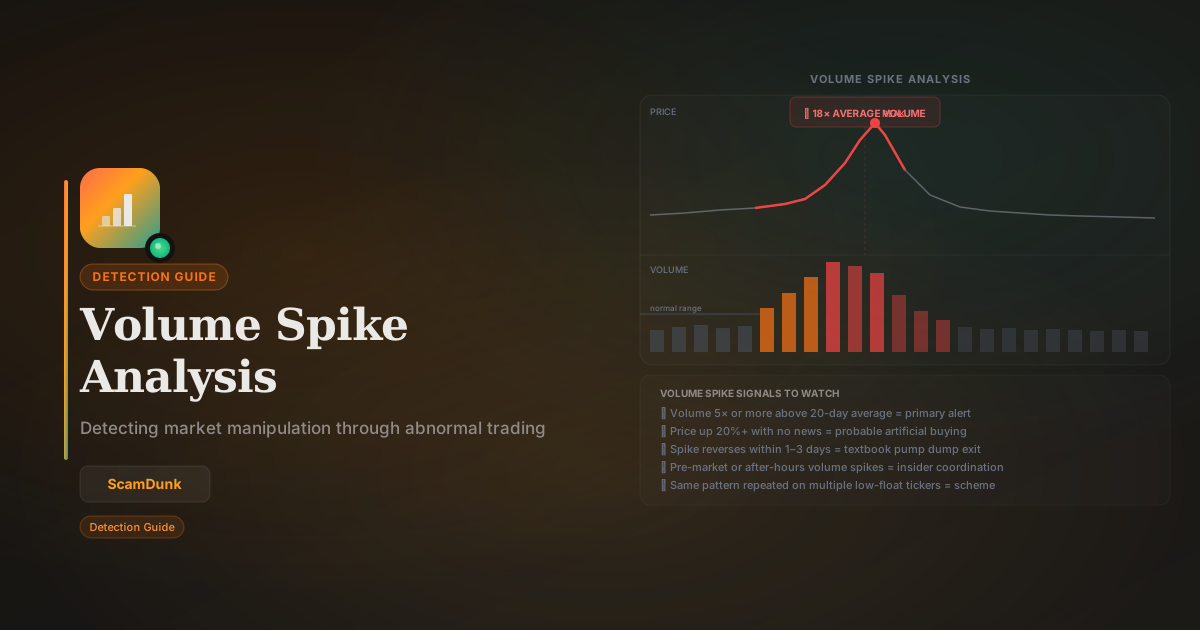
This guide explores how anomalous trading volume spikes can signal potential market manipulation before price changes occur. By understanding the mechanics of volume patterns, investors can distinguish between legitimate trading activity and coordinated schemes, providing a crucial detection window for informed decision-making.
Before a coordinated stock manipulation scheme produces its most visible symptom — a sudden price spike — it always produces a more measurable one: an anomalous trading volume spike. Volume moves first. Price follows. This sequence is not coincidental. It is mechanical. Understanding the mechanics gives investors a detection window that price-only analysis cannot provide.
This guide explains how to read volume patterns, identify the signatures of coordinated manipulation, and distinguish manufactured buying pressure from legitimate trading activity.
What Is a Trading Volume Spike?
Definition: A trading volume spike occurs when a security trades significantly more shares in a given period than its historical average — typically defined as 200% to 1,000%+ of the average daily volume (ADV) over the preceding 20 or 30 trading days.
Volume, in isolation, is neutral information. High volume can signal institutional accumulation, earnings-driven retail interest, news catalysts, short squeeze dynamics, or coordinated manipulation. The context surrounding the volume determines which interpretation is correct.
For small-cap and OTC stocks — the primary targets of retail-facing manipulation schemes — context is almost always available. The absence of legitimate context when volume spikes is itself diagnostic.
Why Volume Precedes Price in Manipulation Schemes
Pump-and-dump operations require two phases: accumulation and distribution. Both are visible in volume data if you know when to look.
The Accumulation Phase
Before operators broadcast a pump signal to their subscriber base, they accumulate shares. This accumulation typically happens over days or weeks before any public promotion begins. At this stage, operators want to buy quietly — large single-day purchases would alert sophisticated market participants. They buy in increments, often through multiple accounts, keeping daily volume close to the stock's historical average.
The signature: gradually increasing volume over 5-10 days before the promotion launches, with no public catalyst explaining the increase. Volume rises from baseline without a corresponding news event or earnings release.
The Distribution Phase
The broadcast signal triggers coordinated retail buying. This drives both volume and price higher simultaneously. Operators sell their accumulated position into this buying pressure. The volume spike at this stage is dramatic: stocks regularly trade 500-3,000% of their average daily volume during coordinated pumps.
The signature: volume reaches its highest single-day level precisely when promotional activity peaks. Price and volume move in lockstep. Then volume collapses as operator selling absorbs all available buying.
This two-phase pattern — gradual pre-promotion accumulation followed by explosive volume at the peak — is the structural fingerprint of organized manipulation. It is distinct from the volume patterns produced by legitimate catalysts.
Legitimate Volume Spikes vs. Manipulation Volume Spikes
Not every volume spike indicates fraud. Distinguishing legitimate from manipulated volume requires examining four variables simultaneously.
Variable 1: The News Catalyst
The most reliable differentiator between legitimate and manipulated volume is whether a verifiable public catalyst accompanies the spike.
Legitimate volume drivers include earnings releases, FDA approvals, merger announcements, significant contract wins, and executive changes. These events are documented on SEC EDGAR (8-K filings), company press releases, and major financial news services.
Manipulated volume is typically accompanied by promotion — social media posts, messaging app alerts, email newsletters — rather than SEC-filed news. A stock moving 200% on 2,000% of average volume with no 8-K filing is almost certainly being manipulated. A stock moving 200% on 2,000% of average volume the day after filing an FDA approval is probably experiencing legitimate reaction.
Check EDGAR for 8-K filings within 48 hours of any significant volume event. The presence or absence of a contemporaneous filing is the first and most reliable filter.
Variable 2: The Company's Trading History
Context matters. A stock that regularly trades 2 million shares per day experiencing a 5 million share day is a 150% spike — notable but not extreme. A stock that averages 50,000 shares per day experiencing a 2 million share day is a 3,900% spike — statistically extraordinary.
Manipulation targets are selected specifically because they have small floats and low average volumes. A small coordinated buy wave can move a thinly traded stock dramatically. Operators do not target liquid, heavily traded companies because moving their price requires too much capital.
High spike ratios (above 500% of ADV) on small, thinly traded stocks are the statistical profile of the manipulation target.
Variable 3: Volume Distribution Throughout the Day
Time-and-sales data (available through most brokerage platforms) shows when volume occurred during the trading day. This distribution reveals operational timing.
Manipulation volume clusters at market open. Operators broadcast signals after market close or early in the pre-market window so that recipients act at the open. The result: volume and price spike dramatically in the first 30-60 minutes, then activity decelerates as the operator sells into the buying wave and retail enthusiasm fades.
Legitimate volume driven by news or earnings distributes more evenly across the trading day, with spikes when different investor segments (retail, institutional, algorithmic) react to and process the news.
A stock whose entire extraordinary volume day occurs between 9:30 and 10:30 AM, followed by declining price and falling volume, is exhibiting manipulation timing — not legitimate catalyst reaction.
Variable 4: Subsequent Price and Volume Behavior
Perhaps the most diagnostic variable is what happens after the spike. Legitimate volume events produce price movement that consolidates at a new level — the new information is priced in, and the stock trades at a new equilibrium. Manipulation volume events produce price spikes that fully retrace. The stock returns to or below its pre-spike price within days.
This retracement pattern occurs because manipulation created artificial demand that the company's actual business fundamentals cannot sustain. When operator selling absorbs the buying pressure, there is nothing left to hold the price at elevated levels.
If a stock spikes 200% on massive volume and then returns to its original price within a week, you are almost certainly looking at the aftermath of a coordinated manipulation event.
The Volume Spike Analysis Framework: Five-Step Process
Apply this framework when evaluating any stock exhibiting unusual volume activity.
Step 1: Calculate the Volume Ratio
Volume Ratio = Current Day's Volume ÷ 20-Day Average Daily Volume
A ratio above 3.0 (300% of average) warrants investigation. A ratio above 10.0 (1,000% of average) on a small-cap or OTC stock is a significant manipulation signal.
Most charting platforms (TradingView, StockCharts, Finviz) display volume ratios automatically. If your platform does not, the calculation requires only the current day's volume and the 20-day ADV, both displayed on any standard chart.
Step 2: Search for a Legitimate Catalyst
Check EDGAR for 8-K filings within 48 hours. Check major financial news services (Reuters, Bloomberg, Yahoo Finance) for press releases. Check the company's investor relations page for announcements.
If no public catalyst is documented and the volume ratio exceeds 3.0, advance to the next step.
Step 3: Map the Intraday Volume Distribution
Review the intraday chart for the volume spike day. Note whether volume concentrates at market open, distributes evenly, or clusters at market close.
Open clustering without a catalyst: manipulation timing indicator. Even distribution with declining volume after initial spike: more consistent with legitimate news reaction.
Step 4: Check for Concurrent Promotional Activity
Search the stock ticker on social media platforms (Twitter/X, Reddit, Telegram, StockTwits) and note the timing of promotional posts relative to the volume spike. Use the SEC's EDGAR full-text search to look for recent registration statements or Form 4 insider selling filings.
Promotional posts preceding or coinciding with a volume spike, combined with no EDGAR-documented catalyst, is the most direct evidence of coordinated manipulation available through open-source research.
Step 5: Track the Post-Spike Price Behavior
Monitor the stock for 5-10 trading days following the spike. Record the high price reached during the spike and the price level 10 days later.
If price returns to within 20% of the pre-spike price, the spike was not driven by a legitimate change in the company's value — it was driven by temporary, artificial demand that has since dissipated.
Volume Spike Patterns by Manipulation Type
Different manipulation schemes produce recognizable volume pattern signatures.
Classic retail pump-and-dump: Single-day volume spike of 500-3,000% of ADV. Price peaks within 1-3 hours of market open. Full retracement within 1-5 days. Promotional activity precedes the spike by 12-48 hours.
Multi-day coordinated accumulation and pump: Volume increases gradually over 5-10 days (accumulation phase), then spikes dramatically on the broadcast day (pump phase), then collapses. Total pattern spans 2-3 weeks. Price retracement takes longer but is equally complete.
Short-and-distort (the inverse scheme): Operator takes a short position, then broadcasts negative misinformation to drive the price down. Volume spikes on selling pressure rather than buying. Price drops sharply, then recovers as the false narrative is corrected. Less common than buy-side manipulation for retail-facing schemes.
Tools for Volume Spike Detection
Free Resources
- Finviz Stock Screener (finviz.com): Screen for stocks with volume above a specific percentage of average. Filter by market cap, price range, and exchange to isolate the small-cap OTC universe most vulnerable to manipulation.
- StockCharts (stockcharts.com): View volume in the context of price history. The relative volume indicator automatically displays current volume as a ratio of historical average.
- SEC EDGAR Full-Text Search (efts.sec.gov): Search for filings referencing a specific ticker to find 8-Ks and Form 4s associated with any volume event.
What ScamDunk Adds
Manual volume spike analysis is time-intensive when applied across hundreds of small-cap stocks simultaneously. Automated pattern detection — flagging stocks that match the specific volume and price behavior profiles associated with manipulation — is the core function ScamDunk's analytical engine performs. The methodology combines volume ratio analysis, promotional activity monitoring, and EDGAR filing cross-reference to surface manipulation signals before the peak.
Frequently Asked Questions About Volume Spike Analysis
What volume ratio is "suspicious" versus normal? There is no universal threshold. The context determines the interpretation. However, as a working rule: a volume ratio above 3.0 warrants investigation. Above 10.0 on a small-cap stock without a documented catalyst is a serious warning signal. Above 20.0 without a catalyst is almost always associated with either manipulation or extraordinary news.
Can volume spikes occur on the downside? Yes. High volume on a declining day can indicate institutional selling, forced liquidation from margin calls, or negative news events. For small caps, high-volume declines following a pump-and-dump peak are the distribution signature — the operator and early participants selling their positions into remaining retail buyers.
How do I distinguish an operator's accumulation from normal institutional buying? Institutional buyers typically produce gradual, consistent volume increases without accompanying price action — they try to minimize their price impact. Operator accumulation on small-cap stocks often shows the same pattern. The distinguishing factor is what follows: legitimate institutional accumulation is followed by continued holding; operator accumulation is followed by public promotion and rapid distribution. You often cannot distinguish them in real time, only retrospectively.
Does FINRA monitor volume spikes? FINRA's Market Regulation unit uses automated surveillance systems that flag unusual trading patterns for investigation. When these flags accumulate around a specific stock or coordinated trading network, they can trigger formal investigations. However, FINRA investigates after the fact; its surveillance does not prevent the pump from occurring. Investor self-protection through the analysis described in this guide operates before the manipulation completes.
What should I do if I already bought a stock that appears to be in a pump-and-dump? This is a risk management decision that depends on your cost basis and the current price. The factual context: the majority of retail participants in pump-and-dump schemes who hold through the dump phase lose more than 50% of their investment. There is no pattern-recognition rule that determines the precise peak before distribution. If you believe you are in a manipulated stock, the asymmetric risk analysis favors exit over continued holding.
The Signal Others Missed
Volume data is public. Every market participant has access to the same charts and the same ratios. The reason manipulation works despite this transparency is that most retail investors look at price, not volume — and they look at promotion, not filing data.
The investors who lose money in pump-and-dump schemes are not missing secret information. They are reacting to the presentation of information (urgent promotional messaging, visible price momentum) instead of the structure of information (volume patterns, EDGAR filings, insider activity).
Volume spikes do not lie. They record what market participants actually did with real money. Promotional messages record what scammers want you to believe.
Read the volume before you read the pitch. The sequence matters.