

Guides
SEC EDGAR for Beginners: Find Red Flags Before Scammers Find You
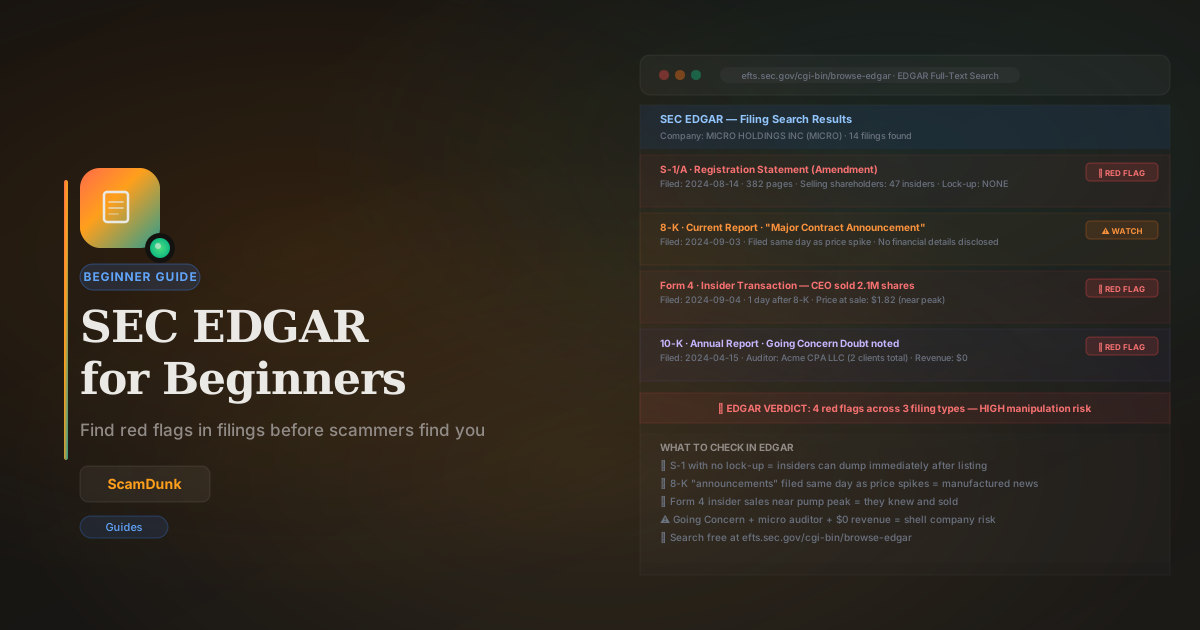
This guide explains how to use EDGAR to find red flags in under ten minutes, without a finance degree or a Bloomberg terminal.
The Securities and Exchange Commission maintains a public database containing filings from every company that legally sells shares to American investors. That database is called EDGAR. It is free, updated daily, and contains the exact information scammers hope you never look up. Most retail investors have never used it.
This guide explains how to use EDGAR to find red flags in under ten minutes, without a finance degree or a Bloomberg terminal.
What Is SEC EDGAR?
Definition: EDGAR (Electronic Data Gathering, Analysis, and Retrieval) is the SEC's mandatory filing database. Any company that sells securities to U.S. investors must file disclosure documents here. These filings are public records, accessible to anyone, at no cost, at https://www.sec.gov/cgi-bin/browse-edgar.
EDGAR contains annual reports (10-K), quarterly reports (10-Q), current event reports (8-K), insider trading reports (Forms 3, 4, and 5), and registration statements for new share issuances. Collectively, these filings create a paper trail that reveals what a company is actually doing, versus what its promoters claim it is doing.
The gap between those two versions is where most scams live.
Why EDGAR Is a Scam Detection Tool
Pump-and-dump schemes require a supply of shares. Those shares had to come from somewhere — and the SEC requires companies to disclose exactly where they came from, how many insiders hold them, and when those insiders are selling.
Scammers cannot hide from EDGAR. They can create fake websites, paid social media campaigns, and WhatsApp groups full of manufactured enthusiasm. They cannot fabricate SEC filings without committing federal securities fraud. This asymmetry is the investor's advantage.
Every coordinated pump-and-dump operation leaves traces in EDGAR filings. The question is whether you look before or after the dump.
How to Search EDGAR: Step-by-Step
Step 1: Find the Company's Filing Page
Navigate to https://efts.sec.gov/LATEST/search-index?q=%22company+name%22&dateRange=custom or use the full-text search at https://efts.sec.gov/LATEST/search-index.
Enter the company name or ticker symbol. Select "All filings" and set the date range to the last 24 months.
If no filings appear, the company may not be required to file with the SEC. This is not reassuring — it is a red flag. Companies that sell shares to U.S. investors without SEC registration are operating illegally, and any promotion of their stock is suspect by default.
Step 2: Locate the Most Recent 10-K or 10-Q
The annual report (10-K) and quarterly report (10-Q) contain the company's financial statements, business description, and management discussion. These documents answer the questions a scam promoter refuses to answer directly:
- How much revenue did the company generate last quarter?
- Does the company have actual customers or only a business plan?
- What do the company's auditors say about its financial health?
- How much cash does the company have and how long will it last?
Read the auditor's report first. A "going concern" qualification — the phrase auditors use when they doubt a company can survive the next 12 months — is dispositive. It does not mean the company is definitely fraudulent. It means professional accountants who reviewed the books believe the company may fail. That context matters when promoters are describing the stock as "ready to explode."
Step 3: Check the Share Structure
Within the 10-K or 10-Q, find the section titled "Description of Capital Stock" or review the balance sheet line items for shares outstanding and authorized shares.
Ask three questions:
How many shares are authorized? Authorization is the legal ceiling on share issuance. A company authorized to issue 10 billion shares that currently has 50 million outstanding has room to dilute existing shareholders by 200x. That dilution potential transfers value from buyers to insiders.
How many shares are outstanding? Cross-reference this with the trading volume you observed. If daily volume is 5% or more of total shares outstanding, the stock is being aggressively traded — either by a legitimate catalyst or by coordinated manipulation.
How many shares are registered for resale? A registration statement (Form S-1 or S-3) that registers millions of shares for resale by "selling shareholders" is the mechanism by which insiders unload shares onto the public. If the registered resale shares represent a large percentage of the total float, insiders are preparing to sell.
Step 4: Review Form 4 Filings for Insider Activity
Form 4 filings are mandatory reports that insiders (executives, directors, and holders of more than 10% of shares) must submit when they buy or sell company stock. They must be filed within two business days of a transaction.
Search for Form 4 filings on the company's EDGAR page. Look for:
- Cluster selling: Multiple insiders filing Form 4s for sales within a narrow window. This is the dump phase of a pump-and-dump scheme.
- Option exercises followed immediately by sales: Insiders exercise options at low strike prices and sell at elevated market prices, extracting value during the pump.
- Sales at prices far above recent trading ranges: Insider sales timed to price spikes suggest the insider had advance knowledge that prices were being artificially elevated.
Legitimate insider selling exists. Executives diversify their holdings. Cluster selling by multiple insiders during a period of unusual promotional activity is a different pattern entirely.
Step 5: Read the 8-K Current Reports
Form 8-K must be filed within four business days of material events: acquisitions, executive changes, new contracts, auditor changes, and financing transactions. Scam-associated companies exhibit specific 8-K patterns:
- Auditor changes, particularly to small, unknown audit firms: major accounting firms refuse to sign off on fraudulent financial statements. A switch from a reputable auditor to an obscure one signals that the company could not pass scrutiny.
- Reverse merger announcements: a legitimate-looking shell company merges with an operating company, circumventing the standard IPO process. This is a common mechanism for introducing fraudulent companies into public markets.
- Repeated debt conversion announcements: convertible notes converting to shares at steep discounts dilute existing shareholders and flood the market with new supply.
The Five EDGAR Red Flags That Signal Manipulation
| Red Flag | What to Look For | Where to Find It |
|---|---|---|
| Going concern qualification | Auditor doubts company survival | 10-K, auditor's report section |
| Excessive share authorization | Authorized shares >> outstanding shares | 10-K, capital structure section |
| Cluster insider selling | Multiple Form 4s filed within days | Form 4 search, EDGAR filing page |
| Auditor downgrade | Switch to unknown audit firm | 8-K, auditor change announcement |
| Registration of resale shares | S-1 or S-3 for selling shareholders | Registration statements section |
Any single red flag warrants caution. Two or more active simultaneously warrants a complete exit from consideration.
What EDGAR Cannot Tell You
EDGAR is a disclosure system. It records what companies report, not whether those reports are accurate. Financial statement fraud — where executives falsify the numbers themselves — is not detectable through EDGAR alone. The SEC brings charges when it detects inconsistencies between filings and independent evidence; it does not audit every filing in real time.
This creates a practical limitation: EDGAR is most useful for detecting structural manipulation patterns (share dilution, insider selling, registration of resale shares) rather than outright financial fraud. Use EDGAR as the first filter, not the final judgment.
For additional verification, cross-reference EDGAR findings with FINRA BrokerCheck for registered brokers involved in the promotion, and the SEC's litigation releases for enforcement actions against company insiders.
EDGAR Verification: A 10-Minute Workflow
If you have received a stock tip and want to verify it before considering any investment:
- Minutes 1-2: Search EDGAR for the company. Confirm it files with the SEC. If it does not, stop here.
- Minutes 3-5: Open the most recent 10-K or 10-Q. Read the auditor's report. Check shares outstanding versus shares authorized.
- Minutes 5-7: Search for Form 4 filings in the last 90 days. Note any cluster selling or post-exercise sales.
- Minutes 7-9: Review 8-K filings in the last 12 months. Look for auditor changes, reverse mergers, or repeated debt conversion events.
- Minute 10: Make a decision. If two or more red flags are present, the risk profile is incompatible with the promoter's narrative.
The promoter told you the stock is going to double. EDGAR tells you whether the people who actually run the company are buying or selling. Those two data points rarely point in the same direction when fraud is involved.
Frequently Asked Questions About SEC EDGAR
Is EDGAR free to use? Yes. EDGAR is a public database maintained by the SEC at no cost to users. No account or subscription is required.
How current is EDGAR data? Filings are typically available within 24 hours of submission. Form 4 insider trading reports must be filed within two business days of a transaction. Annual and quarterly reports have specific deadlines tied to fiscal year-end dates.
What if the company I'm researching doesn't appear in EDGAR? Companies not required to file with the SEC may be exempt because they have fewer than 300 shareholders or below a threshold of total assets. However, any company actively promoted to the public through investment newsletters, social media, or messaging apps should be filing. No EDGAR filings for an actively promoted stock is a disqualifying red flag.
Can a company file false information with the SEC? Yes, and doing so is a federal crime. EDGAR records what companies report; it does not independently verify accuracy. False filings do occur and are the subject of SEC enforcement actions. The SEC's litigation releases (accessible at sec.gov) document enforcement actions against companies that filed false information.
What is a Form S-1 and why does it matter for scam detection? Form S-1 is a registration statement used when a company first registers securities for sale to the public. For existing companies, Form S-3 registers additional shares — often for resale by existing shareholders (insiders and early investors). A large S-3 filing registering millions of insider shares for resale is a direct signal that insiders are preparing to sell into any price increase.
Does EDGAR cover OTC and pink sheet stocks? Many OTC-traded companies file with the SEC. However, the smallest OTC companies — particularly those trading on the OTC Pink marketplace — may not be required to file. These non-reporting companies have the least transparency and historically attract the highest concentration of fraud. Invest with extreme caution in any non-reporting OTC company, regardless of the promotion.
The Transparency Asymmetry
The investor who uses EDGAR is operating with information the promoter assumed you would never bother to find.
Pump-and-dump schemes are designed around the average victim who receives a hot tip and acts on urgency rather than analysis. The entire manipulation depends on buyers who do not look at the filings, who do not check whether insiders are selling, who do not notice that the auditors have already expressed doubt about the company's survival.
EDGAR does not guarantee you will never make a bad investment. Markets are uncertain. Even legitimate companies fail. But SEC filings eliminate the information asymmetry that makes coordinated fraud profitable.
Check the database. Read what the company actually filed. Then decide whether the story matches the documents.
Most of the time, it does not.