

Guides
Pump-and-Dump as a Service: Inside the Industrialization of Stock Manipulation
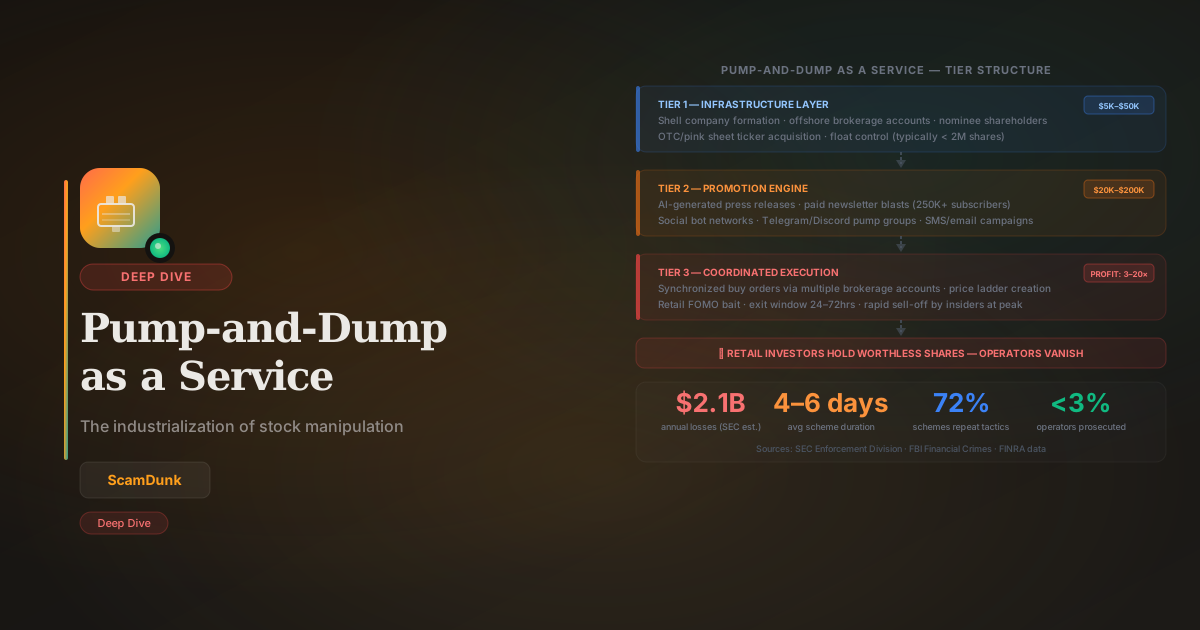
Why modern stock manipulation now runs on platforms, playbooks, and scale
Pump-and-dump schemes have not disappeared. They have professionalized.
For most of modern market history, stock manipulation was episodic and improvisational: boiler rooms, cold calls, fax blasts, thinly traded tickers, and enforcement actions that arrived long after the money was gone. These operations depended on persuasion, friction-heavy distribution, and luck.
ScamDunk’s January 2026 market scan shows that model no longer applies.
Today’s pump-and-dump activity operates as a repeatable, platform-mediated system—optimized for speed, scale, and reuse. The fraud is no longer improvised. It is executed. And critically, it now leaves structural fingerprints in market data before the collapse arrives.
This analysis documents that shift using quantitative evidence: how modern stock manipulation propagates through U.S. equity markets, where it concentrates, how it repeats, and why traditional surveillance continues to lag reality.
Pump-and-Dump as a Service: Definition
“Pump-and-dump as a service” is a descriptive term, not a metaphor.
It does not imply a formal company, legal entity, or centralized organization. It describes a set of operational characteristics repeatedly observed across unrelated stocks and time windows:
- Reusable promotional infrastructure
- Subscription-based or gated access to stock “alerts”
- Standardized promotion and exit timing
- Repeated price-and-volume trajectories
- Predictable post-pump collapse phases
In ScamDunk’s dataset, unrelated securities promoted through the same networks exhibited near-identical pump-and-collapse cycles, often separated by only days. That degree of consistency is not behavioral coincidence. It is operational reuse.
Scope of the Market Analysis
ScamDunk analyzed approximately 5,800–6,700 U.S.-listed equities with sufficient trading history during January 2026, spanning:
- NYSE
- Nasdaq
- NYSE American
- OTC markets
The objective was explicit: detect live manipulation patterns, not catalog fraud retrospectively after enforcement actions.
Key Findings
- ~10% of U.S. micro-cap stocks exhibited manipulation signatures
- Nearly 38% of NYSE American micro-caps triggered high-risk signals
- Fewer than 2% of NYSE-listed stocks showed comparable behavior
- 110 securities completed full pump-and-dump cycles within 15-day windows
This distribution is not random noise. It reflects where manipulation is economically efficient—and where market structure quietly enables it.
How ScamDunk Detects Live Pump-and-Dump Schemes
ScamDunk’s detection architecture is intentionally glass-box. Identical inputs produce identical outputs. There are no opaque heuristics, narrative judgments, or generative assumptions.
Layer 1: Structural Vulnerability Screening
The first layer identifies stocks that are economically feasible to manipulate:
- Market capitalization typically below $300M
- Low average daily trading volume
- Penny-stock pricing (often under $5)
- Minimal institutional ownership
- Little or no analyst coverage
These attributes do not imply fraud. They define mechanical susceptibility.
Layer 2: Statistical Anomaly Detection
Each stock is evaluated against its own historical baseline:
- Seven-day price increases exceeding 25%
- Trading volume surges greater than 3× the 30-day average
- Volatility and momentum inconsistent with prior behavior
The system measures relative deviation, not absolute price movement—because manipulation is about change, not price level.
Layer 3: Machine-Learning Classification
Supervised models—trained and validated against confirmed enforcement cases and post-collapse patterns—assess whether observed anomalies resemble manipulation rather than legitimate catalysts.
Backtesting against 30 SEC enforcement cases (2020–2024) showed an 87% detection rate prior to collapse, with low false positives in the highest-risk tier.
That matters less as a marketing statistic than as a timing signal: the window exists before liquidity vanishes.
Layer 4: Cross-Stock Pattern Matching
The final layer compares behavior across securities, not just within them:
- Synchronized pump windows
- Similar volume-before-price sequences
- Repeated acceleration and collapse timing
When unrelated companies move in mechanically identical ways within compressed timeframes, coincidence stops being a serious explanation.
Why NYSE American Is Disproportionately Targeted
The most striking result in the data is concentration.
- NYSE American: ~35–38% of micro-cap listings flagged as high risk
- NYSE: ~1.7–2.9%
That is a 22× disparity.
NYSE American occupies a narrow structural niche: exchange-listed legitimacy combined with market caps small enough to move on mid-five-figure capital. Liquidity is thin, scrutiny is limited, and analyst coverage is sparse.
It offers credibility without resistance. The data suggests manipulators have noticed.
From Market Volatility to Manipulation Infrastructure
Viewed in isolation, any one stock can be dismissed as speculative excess. At scale, that explanation collapses.
ScamDunk observed:
- Hundreds of stocks in active pump phases simultaneously
- Dozens entering and exiting pump cycles within identical windows
- Mechanical repetition across sectors, geographies, and market caps
This is the transition from volatility to infrastructure.
Modern manipulation depends less on persuasion and more on coordination mechanics: distribution channels, alert timing, and liquidity engineering. The story is no longer psychological. It is operational.
The Modern Pump-and-Dump Lifecycle
Across completed cases, the lifecycle is highly consistent:
Pre-positioning Trading volume increases before price movement. Accumulation occurs quietly.
Promotion ignition Time-stamped alerts are distributed via social and messaging platforms, often through paid or gated channels.
Acceleration Prices rise 200–600% within days. Volume exceeds historical norms by multiples.
Exit Insiders sell into demand. Momentum indicators reach extreme overbought levels.
Collapse Liquidity evaporates. Prices fall 40–70% from peak, often within one to two weeks.
Losses concentrate at the end of the cycle. The asymmetry is temporal, not informational.
Detection vs. Enforcement: The Structural Gap
If manipulation is this widespread, why isn’t enforcement proportional?
Because detection and prosecution solve different problems.
Algorithms identify statistical patterns. Courts require proof of intent—trading records, communications, and testimony—accessible only through subpoenas. That gap is not analytical. It is institutional.
ScamDunk’s 10% detection rate versus historical SEC enforcement rates (2.8%) reflects capacity constraints, not overreach. Modern schemes operate in days. Enforcement operates in months or years. By the time a case is built, the trade is finished.
Investor Impact and Capital at Risk
Investment fraud is already the largest consumer fraud category by dollar losses in the United States. ScamDunk’s dataset quantifies where those losses accumulate.
Across the 110 highest-risk securities:
- Estimated retail exposure: $650M–$1.1B
- Average declines from peak: 45–62%
- Stocks still in active pump phases: $4–7B in unresolved downside risk
This is not abstract harm. It is mechanical transfer—late liquidity funding early exits.
What This Means Going Forward
The critical shift is not technological novelty. It is organizational maturity.
Pump-and-dump schemes have evolved from opportunistic fraud into repeatable market operations that reuse infrastructure, timing, and execution logic across tickers. That evolution makes them more dangerous—but also more legible.
When manipulation becomes standardized, it becomes detectable before collapse.
ScamDunk’s role is not to predict prices or allege fraud. It is to identify when market behavior stops being organic and starts being engineered.
At scale, that distinction is no longer academic. It is defensive.
Data, methodology, and full ticker lists are available to journalists, researchers, and regulators on request. ScamDunk provides risk intelligence, not investment advice.