

Guides
Detecting Penny Stock Scams: A Forensic Investor's Guide
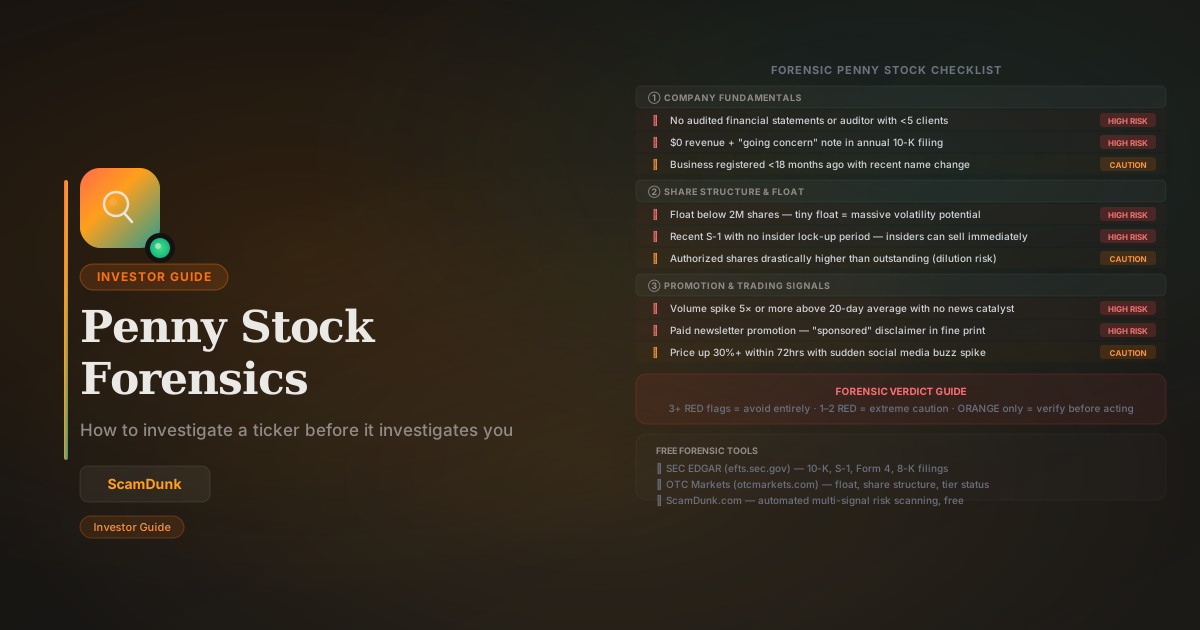
Penny stocks are a high-risk segment of the equity market, often attracting both legitimate investors and fraudsters. This handbook outlines a forensic framework for identifying and distinguishing between genuine investments and manipulative schemes, detailing various fraud types and a 10-point detection system to protect investors.
Penny stocks occupy the highest-risk segment of the equity market. Securities trading below $5 per share—often on OTC venues rather than major exchanges—attract both legitimate speculative interest and systematic fraud. This handbook lays out a forensic framework to separate the two.
Why Penny Stocks Attract Fraud
Structural features make penny stocks unusually easy to manipulate. Detection starts with understanding the terrain.
Low Float Mechanics
“Float” is the number of shares available for public trading. Penny stocks often have floats between 500,000 and 20 million shares. Compare that to Apple, with 15+ billion shares outstanding.
Small floats mean limited supply. When demand spikes—organic or manufactured—prices can move violently. A coordinated $50,000 buy into a stock with a 2 million share float can drive a sharp move; the same $50,000 in a large-cap barely registers.
Manipulators target low-float names because the capital required to move the price is manageable: accumulate, promote, trigger buying pressure, then dump into it.
Limited Analyst Coverage
Major Wall Street firms generally don’t cover penny stocks. The market cap and trading economics don’t justify the research budget. The result is an information vacuum—exactly where promoters thrive.
In large caps, claims get stress-tested against analyst models, institutional memory, and earnings scrutiny. In penny stocks, the promoter’s narrative may be the only narrative.
Regulatory Arbitrage
Many penny stocks trade on OTC markets (e.g., Pink Sheets, OTCQB) with lighter listing and disclosure requirements than NYSE or Nasdaq.
Some issuers are small and early-stage. Others are structurally suspect: shells, companies that can’t meet audit standards, repeat offenders recycling corporate entities. Lower barriers create more “vehicles” that can be dressed up as operating businesses.
Retail-Dominated Trading
Institutions largely avoid penny stocks due to liquidity constraints, mandate restrictions, and reputational risk. That leaves the market dominated by retail.
Retail markets are easier to move with hype. Institutions can verify claims, detect manipulation, and short frauds. Most individuals can’t. The asymmetry is the point.
The Penny Stock Fraud Taxonomy
Fraud isn’t one thing. Pattern recognition matters.
Classic Pump-and-Dump
Manipulators accumulate shares, promote aggressively via social/messaging channels, sell into the buying pressure, and vanish.
Characteristics: volume explosions, coordinated messaging, urgency language, collapse within days of the peak.
Time horizon: typically 1–4 weeks end-to-end.
Reverse Merger Fraud
A private company merges into a public shell to go public without IPO-level scrutiny. Some are legitimate; many are exploited.
Characteristics: sudden business “transformation,” new management with unclear history, promotional surge immediately after the merger.
Red flag: a dormant shell for years suddenly becomes a “revolutionary” company overnight.
Pump-and-Suspend
The SEC can suspend trading for up to 10 days when manipulation is suspected, trapping investors who can’t exit.
Between 2020 and 2024, the SEC suspended trading in 300+ securities due to manipulation concerns. When trading resumes, prices often reopen 80–95% lower.
Characteristics: looks like pump-and-dump until a suspension intervenes—turning late-stage buys into trapped losses.
Long-Form Fraud
More sophisticated operations build credibility over months or years before extracting value.
Pattern: plausible story → steady press releases → retail following → capital raises/offerings → fundamentals later revealed as exaggerated or fabricated.
Harder to detect because legitimate companies can look similar early. The difference is depth of verification.
The 10-Point Forensic Detection System
This is an investigative checklist. Each point has methods and red flags.
Point 1: Corporate History Analysis
Pull the full filing history from SEC EDGAR and read the story in sequence.
Examine:
- How long has the company existed? When did it begin SEC reporting?
- Name changes (often attempts to break associations).
- Radical business pivots (e.g., “mining exploration” → “blockchain AI”).
- Evidence of shells/reverse mergers (look for origin details, Form 10 where relevant).
Red flags: multiple name changes, discontinuous business identity, shell history, gaps in filings.
Point 2: Management Background Verification
Penny stock fraud often recycles people. Verify management is not a repeat pattern.
Method:
- Pull officers/directors from latest 10-K/10-Q (or proxy).
- Search names with: “SEC enforcement,” “securities fraud,” “pump and dump.”
- Verify credentials via LinkedIn and prior company history.
- Check whether prior associations also ended in failure, dilution spirals, or fraud allegations.
Red flags: no real online presence, unverifiable credentials, repeat penny stock involvement, SEC enforcement history.
Point 3: Auditor Quality Assessment
Not all auditors are equal. In penny stocks, auditor choice is often a signal.
Method:
- Identify auditor in the latest 10-K audit opinion.
- Search auditor + “PCAOB” to locate inspection/sanction history.
- Check for recurring deficiencies.
- See how many similar penny names use the same auditor.
Red flags: repeated PCAOB deficiencies, auditor serving mostly penny issuers, frequent auditor switches, auditor geography inconsistent with ops.
Point 4: Related Party Transaction Examination
Related-party deals create clean channels for value extraction.
Method:
- Search filings for “related party.”
- Identify relationships, amounts, and terms.
- Ask whether services are real and priced at market.
- Map related parties to prior problematic entities.
Red flags: large payments to insider-controlled entities, vague service descriptions, related parties with bad histories, transactions disproportionate to business needs.
Point 5: Revenue Recognition Analysis
If a penny stock claims revenue, prove it exists and is durable.
Method:
- Compare revenue to accounts receivable (AR). AR rising faster than revenue is a classic warning.
- Check customer concentration disclosures (10%+ customers).
- Look for revenue from related parties.
- Find external evidence the product/service is actually being purchased.
Red flags: AR growth outpacing revenue, “customers” that can’t be identified, no visible commercial activity, related-party revenue.
Point 6: Cash Flow vs. Earnings Divergence
Over time, operating cash flow should broadly track net income. Persistent divergence is a quality or integrity problem.
Method:
- Compare net income vs. operating cash flow across multiple quarters.
- If income is positive and operating cash flow negative, identify what’s driving paper profits.
- Review non-cash items (including heavy stock-based comp).
Red flags: repeated positive earnings with negative operating cash flow, earnings driven by non-cash adjustments, capital raises despite “profitability.”
Point 7: Capital Structure Analysis
Financing tells you what management thinks the equity is actually worth.
Method:
- Read “Liquidity and Capital Resources.”
- Identify toxic structures: floating-price convertibles, repriced warrants, preferred conversions.
- Calculate fully diluted shares (options/warrants/convertibles) and compare to float.
Red flags: frequent discounted raises, structures enabling massive dilution, serial down-rounds.
Point 8: Promotional Activity Assessment
In penny stocks, promotion is often the business model.
Method:
- Search ticker across X/Twitter, Reddit, StockTwits; track timing and velocity.
- Check paid newsletter databases.
- Identify paid IR firms and research their history.
- Look for required disclaimers (often buried).
Red flags: sudden coordinated campaigns, paid newsletter pushes, IR shops with bad track records, missing/hidden disclosures.
Point 9: Press Release Pattern Analysis
Press releases can be operational updates—or synthetic activity designed to move a chart.
Method:
- Read all press releases from the last year (site + filings).
- Separate substance from fluff (named contracts vs. “exploring opportunities”).
- Track whether announced deals actually close.
- Compare press timing to price/volume anomalies.
Red flags: unverifiable claims, repeated “potential” deals that never land, claims inconsistent with filings, releases synced with suspicious trading.
Point 10: Technical Trading Pattern Analysis
Charts can reveal market structure—and interference.
Method:
- Review a 6-month daily chart.
- Look for: consolidation → vertical spike → immediate collapse.
- Compare volume on up days vs. down days.
- If options exist, scan for unusual options pre-news.
- Check history for halts.
Red flags: repeated spike/collapse cycles, extreme volume asymmetry, options leading news, prior halts.
Applying the Framework: Decision Matrix
After all 10 points, classify the name based on evidence density.
Verification Passed (Rare)
- Consistent operating history and business identity
- Verifiable management with clean background
- Reputable auditor with clean inspection history
- Minimal related-party extraction
- Revenue appears real with diversified customers
- Cash flow supports earnings
- Capital structure not designed for dilution
- Promotion proportional to substance
- Press releases contain verifiable claims
- Trading patterns look organic
If it passes, standard investing questions apply: valuation, moat, growth, execution risk.
High Risk (Common)
Multiple “yellow flags” that could be benign but require tight monitoring.
Proceed only with:
- small position sizing (money you can lose),
- predefined stop losses and profit targets,
- an exit plan before entry.
Avoid (Most Common)
Three or more red-flag points—or one critical red flag (shell history, prior fraud associations, toxic financing).
Do not buy regardless of hype, momentum, or price action. If you already hold, consider exiting regardless of current P&L.
Platform-Specific Considerations
OTC Markets Tier Analysis
OTC Markets Group tiers:
- OTCQX: highest tier; stronger standards; lower risk, not zero
- OTCQB: mid-tier; SEC reporting + annual verification; moderate risk
- OTC Pink (Pink Sheets): minimal requirements; highest risk; includes “caveat emptor” designations (often marked with a skull/crossbones)
Check tier status at OTC Markets. “Caveat emptor” is not a suggestion; it’s a warning label.
Exchange-Listed Penny Stocks
Some penny-priced stocks trade on NYSE/Nasdaq. Listing rules reduce risk but don’t erase it.
Apply the full framework. Also watch for delisting notices (often in 8-Ks). A listing that’s failing is a signal to re-run the dossier.
Case Recognition Patterns
Pattern A: The Dormant Shell Revival
Signature: years of inactivity → sudden new business story + new management + immediate promotion.
Mechanism: control of shell changes hands → minimal assets injected → heavy retail promotion → value extracted via share sales/financings.
Detection: discontinuity in filings, management lacks credible industry track record, “transformation” not matched by revenue reality.
Pattern B: The Perpetual Development Story
Signature: always “one milestone away,” never commercializing.
Mechanism: endless press releases, serial dilution, management extracts value through comp and related-party channels.
Detection: multi-year hype with weak financial translation, repeated discounted raises, compensation detached from performance.
Pattern C: The Coordinated Social Media Pump
Signature: simultaneous appearance across platforms with synchronized bullish language.
Mechanism: quiet accumulation → coordinated WhatsApp/Discord/Telegram/X/Reddit push → rapid dumping → collapse.
Detection: promotion velocity spikes without a real catalyst, massive volume surge, fast mean reversion, narrative disappears.
Frequently Asked Questions
Are all penny stocks scams?
No. Some legitimate small companies trade at penny prices due to stage, sector cycles, or small market size. The difference is verification depth. Legitimate names survive the 10-point framework. Fraud vehicles don’t.
Can I profit from penny stocks even knowing they’re risky?
Possible, but the discipline requirements are non-negotiable: position sizing you can lose, predefined exits, and emotional detachment. Most retail losses come from poor risk control, not bad luck.
Should I short penny stocks I identify as fraudulent?
Usually no. Borrow is scarce and expensive, squeezes are common, and timing is unpredictable. You can be right on substance and still lose on structure.
What about SEC enforcement?
Enforcement exists, but it’s structurally out-resourced relative to fraud volume. Many schemes complete before intervention. Don’t outsource protection to regulators—verify and manage risk yourself.
How much time should I spend on this analysis?
A thorough run through the 10 points takes 30–60 minutes. If you’re not willing to spend that time, you’re not entitled to risk that capital. Analysis depth should dictate position size.
Conclusion
Penny stocks sit in a market where fraud is endemic. The same characteristics that define the segment—low float, thin coverage, retail dominance—also enable manipulation.
That doesn’t mean every penny stock is uninvestable. It means verification is mandatory.
Most stocks you run through this system will fail. That’s expected. The goal isn’t to find easy wins. It’s to avoid catastrophic losses.
For the rare names that pass verification, normal discipline still applies: size appropriately, define exits, and keep monitoring. A penny stock that passes today can still deteriorate tomorrow.
Penny stocks offer asymmetric outcomes. Your posture must be asymmetrically cautious.
Verify thoroughly. Size appropriately. Exit decisively.
The money you don’t lose compounds better than the money you “almost” made.