

Security Tips
Navigating the Stock Manipulation Landscape on Twitter/X: Essential Red Flags for Investors
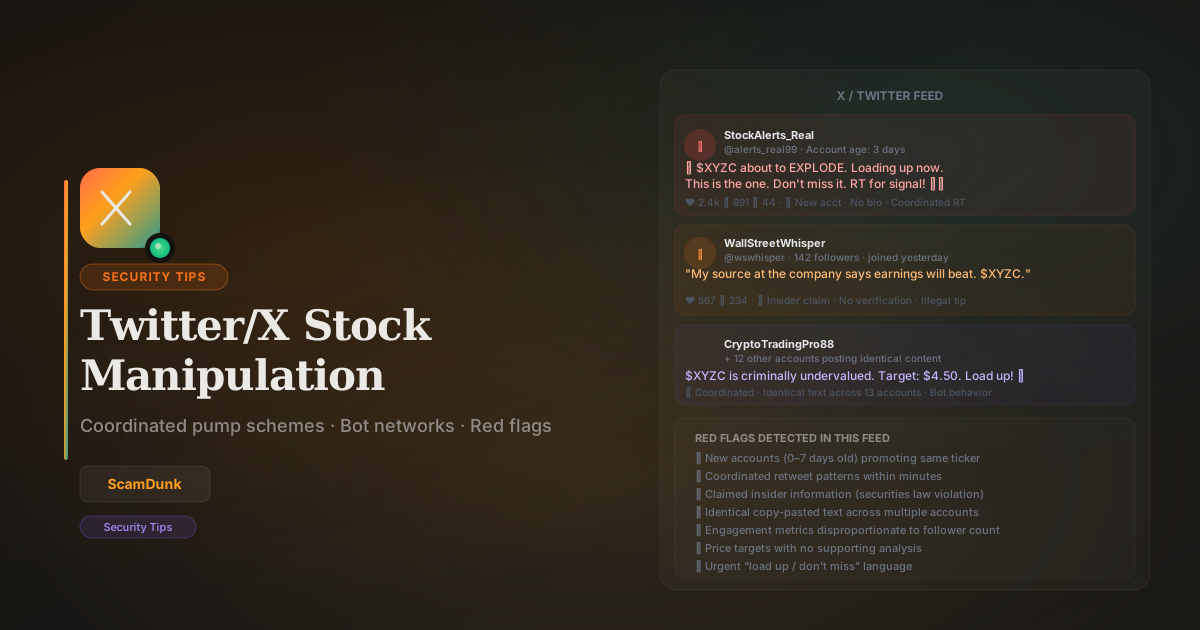
This blog post explores the alarming rise of stock manipulation on Twitter/X, highlighting the platform's unique structural features that facilitate fraudulent activities. It provides investors with a detailed guide to identifying red flags associated with coordinated stock promotion, including suspicious account behaviors and engagement patterns that can help differentiate between legitimate discussions and manipulative tactics.
Twitter/X has displaced every other public platform as the primary real-time distribution channel for stock manipulation. The reasons are structural: public posts indexed by search engines, real-time amplification through retweets, a follower system that creates concentrated distribution networks, and a verification system that can be purchased — not earned. The SEC filed more enforcement actions related to Twitter/X stock promotion in 2024 than in any prior year. The volume of manipulation on the platform has not declined since then.
This guide identifies the specific account behaviors, post structures, and engagement patterns that distinguish coordinated stock manipulation from legitimate market discussion.
Why Twitter/X Is the Manipulation Platform of Record
Definition: Stock promotion on Twitter/X refers to any communication on the platform that encourages the purchase of a specific security, whether or not the promoter discloses a financial interest in that security's price movement.
The SEC requires anyone paid to promote a stock to disclose that compensation — a rule violated by the majority of social media stock promoters operating today. A 2024 report from the SEC's Office of Investor Education and Advocacy found that fewer than 15% of social media accounts involved in identified stock promotion schemes disclosed their compensation in their posts.
Twitter/X accelerates manipulation for four reasons that other platforms do not combine as effectively:
Search indexability: Ticker symbols (e.g., $TICKER) are searchable in real time, allowing promoters to reach investors actively researching a stock at the moment of peak promotional activity.
Algorithmic amplification: The platform's engagement algorithm amplifies posts that generate rapid likes, replies, and reposts. Coordinated manipulation networks exploit this by deploying multiple accounts to engage with promotional posts in the first minutes after publication, triggering wider algorithmic distribution.
Paid verification: The platform's blue check mark, once a credibility signal based on identity verification, can now be purchased. This creates account authority that retail investors may interpret as legitimacy without its historical meaning.
Account anonymity: The platform allows pseudonymous accounts with no identity verification, enabling operators to create networks of accounts with no regulatory traceability.
The 13 Twitter/X Red Flags for Stock Manipulation
Red Flag 1: The Account's Post History Is Exclusively Stock Picks
Review the account's timeline going back 90 days. A legitimate market participant — an investor, analyst, or trader sharing ideas — discusses a range of topics: markets generally, specific sectors, economic conditions, their analytical methodology, and occasionally picks. Their timeline reflects a person who thinks about markets.
A promotional account has one function. Scroll back through its history and you will find an unbroken sequence of pick alerts, gain screenshots, and follower engagement posts. No discussion of methodology. No losing trades. No engagement with market conditions that would affect the picks. The account exists solely to distribute buy signals, not to build analytical knowledge.
Red Flag 2: Follower-to-Engagement Ratio Is Broken
An account with 80,000 followers should generate substantial engagement on popular posts — hundreds of likes, dozens of replies, regular reposts. If a high-follower account generates consistent low engagement (fewer than 50 likes per post), the follower count was purchased from a bot service.
Purchased followers are common in promotional account networks. They create the appearance of authority and reach that organic growth would have taken years to build. Real-time engagement ratios reveal the fraud: bots do not like or reply.
Calculate engagement rate as total interactions (likes + replies + reposts) divided by follower count. Above 1-2% per post is plausible. Below 0.1% consistently indicates a bot-inflated audience.
Red Flag 3: Accounts Reference Each Other in Coordinated Posts
Monitor whether multiple accounts post about the same ticker within a narrow time window — often within 30-60 minutes of each other. This is the coordination signature.
Independent investors who discover the same stock will not post about it simultaneously. Coordinated networks post simultaneously because they receive the same signal from a coordinating operator. The posts may be slightly varied in language (to avoid algorithm detection) but reference the same ticker, the same price target, and the same urgency framing.
When you see four accounts with similar follower counts, similar post histories, and similar aesthetics posting about the same small-cap stock within an hour of each other, you are observing a coordinated network, not independent convergence.
Red Flag 4: The $TICKER Cashtag Appears in Posts with No Analysis
Legitimate market discussion uses cashtags as reference, not as the entire content. A post like "$PLXP — This is it. 300% incoming. Don't miss it." contains no information. There is no reason to believe in the price target, no analytical basis for the claim, and no mechanism described.
The absence of analytical content is diagnostic. Promoters are not providing investment analysis. They are providing distribution — broadcasting a ticker to a broad audience on behalf of an operator who needs buying pressure. The post's purpose is to get you to search the ticker and click buy, not to give you information that helps you evaluate the trade.
Red Flag 5: Screenshots of Brokerage Gains Without Trade Context
Accounts that regularly post screenshots of extraordinary gains — portfolios up 400%, specific trades returning $30,000 in a day — are providing social proof with no verifiable content.
These screenshots prove nothing. Any brokerage interface can be screenshot-doctored in minutes. Paper trading accounts show identical interfaces to real money accounts. Historical accounts can be cherry-picked to show only winners. Even genuine screenshots can show different time periods than implied.
Legitimate traders who share performance data provide context: their overall portfolio, their win/loss record, the trade thesis, and the risk management rules they applied. A stream of gain screenshots with no context is a fabrication designed to drive follower trust.
Red Flag 6: Profile Signals Authority Without Verifiable Credentials
Account bios in promotional networks typically include: "Made $X million trading," "Former [financial institution] analyst," "Featured in [major publication]," "Top 1% trader," or similar authority claims.
None of these claims can be verified from the profile. FINRA BrokerCheck allows verification of registered broker-dealer employees and investment advisers. If an account claims professional finance credentials, search BrokerCheck. If the name does not appear, the credential is fabricated.
Unregistered individuals providing specific investment recommendations for compensation are violating securities law, regardless of whether their recommendations are also part of a manipulation scheme.
Red Flag 7: "#AD," "#Sponsored," or Compensation Disclosure Is Absent
The SEC requires anyone compensated to promote a security to disclose that compensation in the promotional content itself. This requirement applies to social media posts.
Review any stock promotion post for disclosure language. The disclosure must be clear and conspicuous — not buried in a linked bio page, not included in a thread reply three posts down, not implied by a generic "not financial advice" disclaimer.
A post promoting a specific stock with a specific price target from an account that receives compensation for promotion, without disclosure, is a violation of SEC Rule 10b-5. The legal standard does not require intent to defraud — the non-disclosure is itself the violation.
Red Flag 8: Post Volume Spikes Precisely at Market Open or After Close
Promotional posts are timed for maximum impact. Before market open (7:00-9:30 AM ET) is the most common posting window: subscribers see the promotion, set up their brokerage, and buy at the open. This is the coordinated buy wave that creates the opening price spike operators need for their distribution.
After-hours posting is also common: operators post when the market is closed to allow maximum subscriber engagement time before the next opening bell.
Accounts that post almost exclusively in these windows, about specific tickers, are running timed distribution operations rather than sharing organic market observations.
Red Flag 9: "Not Financial Advice" Disclaimers Are Used as Legal Cover, Not Caution
"NFA," "DYOR," and "not financial advice" disclaimers have become reflexive inclusions in promotional posts. They do not create legal protection for the promoter, and they do not excuse failure to disclose compensation. Their presence has been so thoroughly associated with manipulation networks that it now functions as an identification signal rather than a genuine disclaimer.
The genuine red flag: a post that provides a specific ticker, a specific price target, and a specific urgency frame — all the elements of an investment recommendation — followed by "NFA" is attempting to claim the exemptions of casual commentary while providing the substantive content of professional advice.
Red Flag 10: The Account Was Created Within the Last 12 Months
Search the account's creation date (visible on the profile on most browser views of Twitter/X). Manipulation networks have high turnover: accounts are banned, abandoned after schemes complete, or retired to avoid regulatory attention. New accounts are created regularly to replace them.
A high-follower account created within the past 12 months, posting exclusively about small-cap stocks, with the characteristics described above, is likely a replacement account in an ongoing network. The follower count was purchased; the account's "track record" is unverifiable.
Red Flag 11: "DD" Posts Contain No Primary Research
"Due diligence" posts on Twitter/X are a genre. Long threads presenting a stock investment thesis, complete with charts, price targets, and bullish catalyst narratives. These appear to be analytical work.
Examine the sourcing. Does the DD cite SEC filings, earnings transcripts, or industry reports — all verifiable primary sources? Or does it cite the company's own press releases, management interviews, and other promotional materials that the company itself controls?
Promoter-generated "DD" typically uses only company-provided information. It presents the company's narrative without verification. This is not analysis — it is amplification. The analytical framing creates credibility while the sourcing structure ensures only the operator's preferred narrative is presented.
Red Flag 12: Replies Are Filled with Bot-Engagement Accounts
Examine the reply section of promotional posts. Replies to legitimate posts come from varied accounts with diverse posting histories. Replies to promotion posts are frequently populated by accounts that exist solely to agree enthusiastically: "This is the one," "Already up," "Great call," "Bought 10,000 shares."
Check these reply accounts. They typically have: minimal posting history outside of positive replies to promotional accounts, zero followers of their own, and creation dates clustered around the same period. These are engagement farms — manufactured social proof designed to make the promotion appear to have genuine community support.
Red Flag 13: The Stock Being Promoted Has No Visible News Catalyst
The final verification: search for news about the promoted stock on major financial news services (Reuters, Bloomberg, MarketWatch, Yahoo Finance) for the 30 days preceding the promotion.
If a stock is being aggressively promoted on Twitter/X with price targets and urgency language, and no verifiable public catalyst appears in major news coverage, the promotion is the news. The information asymmetry the promoter claims to have — "getting in before the news drops" — is fictional. There is no news. There is only the promotion.
How to Verify a Twitter/X Stock Account Before Acting
Step 1: Run FINRA BrokerCheck
Search the account operator's claimed name at finra.org/brokercheck. Registration status is the first filter. Unregistered individuals providing specific investment recommendations for compensation are violating securities law.
Step 2: Search SEC EDGAR for the Promoted Ticker
Open the company's EDGAR filing page and confirm: it files with the SEC, the most recent filings do not carry going concern qualifications, there are no clustered Form 4 insider selling filings, and no large S-3 resale registrations are pending.
Step 3: Check SEC Enforcement Actions for the Account Name or Ticker
Search sec.gov/litigation for the promoted ticker symbol and the operator's claimed name. Prior enforcement actions are disqualifying.
Step 4: Calculate the Engagement Ratio
Total interactions on the last 10 posts divided by follower count. Below 0.2% consistently indicates a purchased audience, not an organic community.
Step 5: Verify the Account Creation Date and Cross-Platform History
A high-follower account with a recent creation date and no history outside of stock promotion is an operational account, not an investor identity.
Frequently Asked Questions About Twitter/X Stock Manipulation
Is it legal to discuss stocks on Twitter/X? Yes. Discussing investments, sharing analysis, and recommending stocks to others is legal. What is illegal: receiving compensation to promote a security without disclosing that compensation, making false statements about a company to manipulate its stock price, and coordinating with others to buy or sell in ways that artificially manipulate prices.
Does paying for a blue checkmark make an account more credible? No. The blue check on Twitter/X now indicates only that the account holder pays a subscription fee, not that their identity has been verified or that their credentials have been confirmed. Do not use the check mark as a credibility signal.
Can the SEC see Twitter/X posts? Yes. The SEC's Division of Enforcement monitors social media platforms, issues subpoenas to platforms for account information, and has successfully identified and prosecuted individuals who ran pump-and-dump schemes through Twitter/X. Platform anonymity does not provide legal protection.
What is a "fintwit" pump? "Fintwit" (financial Twitter) refers to the community of investors and traders who use Twitter/X to discuss markets. Legitimate fintwit exists and includes credentialed analysts and researchers. The same term is sometimes applied to the promotional networks described in this article. Evaluate accounts by their characteristics, not by their association with the fintwit label.
What should I do if I identify a coordinated manipulation network on Twitter/X? Report directly to the SEC at sec.gov/tcr. Include the account names, post timestamps, the promoted ticker, and any coordination patterns you observed. Screenshot evidence before reporting — posts are often deleted after schemes complete. Your report contributes to investigation data even if no individual action results.
The Platform Serves the Promoter
Twitter/X did not design its features for stock manipulation. But every feature that makes it effective as a real-time public communication platform — search, algorithmic amplification, rapid sharing, accessible account creation — equally serves the manipulation operator's operational needs.
The investor who understands this dynamic stops reading promotional posts as signals and starts reading them as artifacts — evidence of an operation in progress, not information about a genuine opportunity.
When you see the red flags described above clustering around a small-cap ticker, you are not seeing an investment opportunity others have discovered. You are seeing a distribution network executing against you.
The playbook is not new. The platform is. The response is the same: verify before you act, and the verification will almost always tell you to do nothing.